

Most out-of-school time (OST) programs, whether run by a nonprofit or a school district, are already tracking data, whether they think of it that way or not. Daily attendance gets logged. Families fill out enrollment forms. Staff jots down notes on which activities kids show up for. In short, the raw material for a clear picture of the program is usually already sitting somewhere.
A stack of attendance sheets holds real information. So does a half-updated spreadsheet. However, neither one tells anyone anything on its own. Someone still has to turn that information into after-school data reporting for it to be useful. That step often gets skipped, simply because staff doesn’t have the time for it.
What data tracking actually looks like
After-school programs typically track four types of data. These are attendance and headcounts, enrollment and demographic records, and engagement across activities. Programs that measure outcomes directly also track results from surveys or observation tools.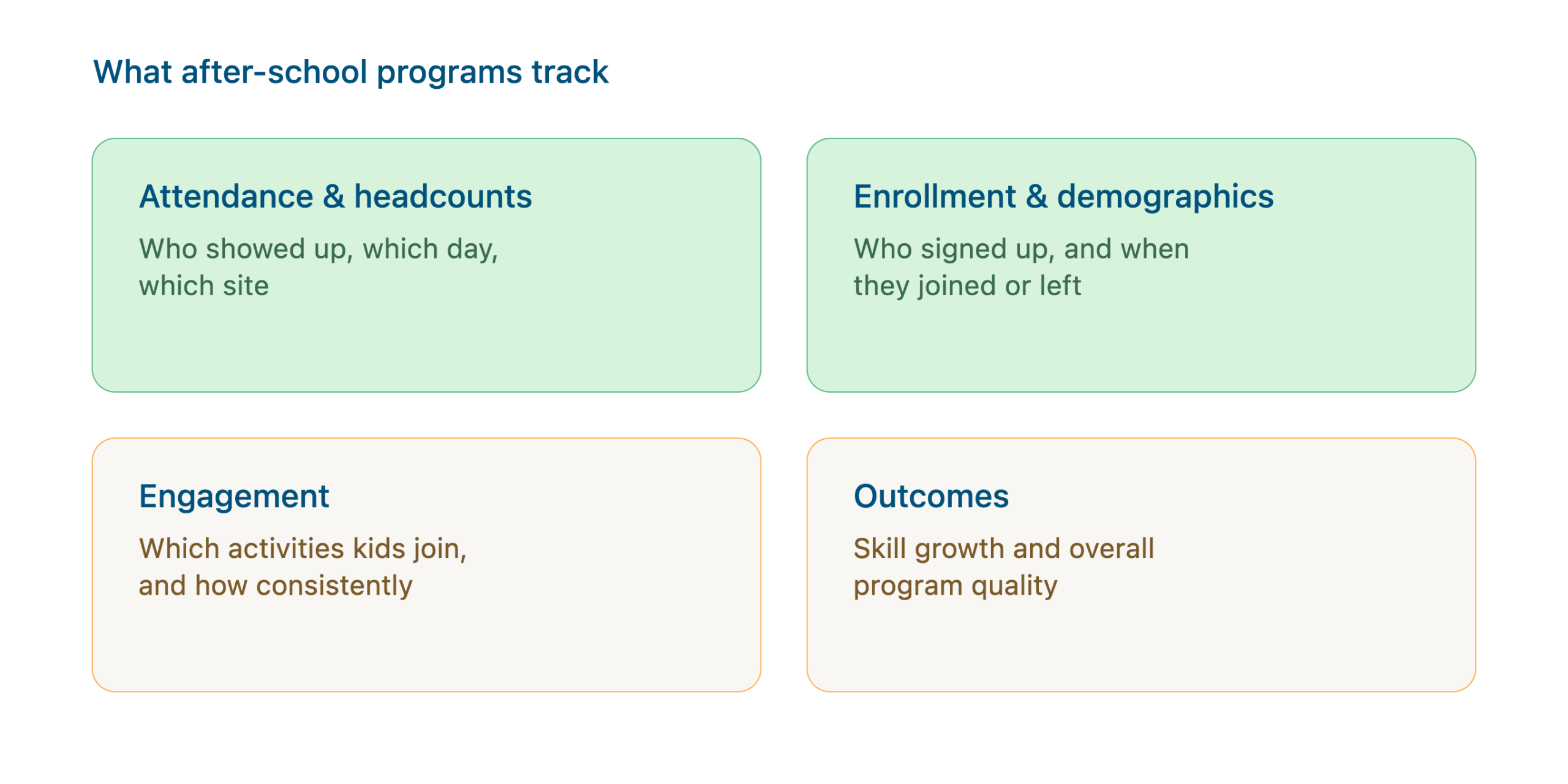 Attendance and headcounts, what most programs call attendance tracking, capture who showed up, on which day, and at which site. Enrollment and demographic records track who’s signed up, and when they joined or left. Engagement data reflects which activities kids participate in, and how consistently. Outcome data feeds into the school district’s program outcomes reporting, capturing measures such as skill growth and overall program quality.
The Wallace Foundation’s Measuring Youth Development: How Out-of-School Time Programs Collect and Use Data examined how OST programs handle this kind of tracking. It found that program leaders want data that answers a specific set of questions. Those questions include how the program is running, how well it’s performing, who’s benefiting, and what might improve it.
Most programs are already collecting data that could answer those questions. Staff capacity is usually the obstacle. Turning raw records into something usable takes time, and many programs simply don’t have it. According to the Wallace Foundation, the problem gets worse when different funders request the same information in different formats.
Why a report changes what programs can see
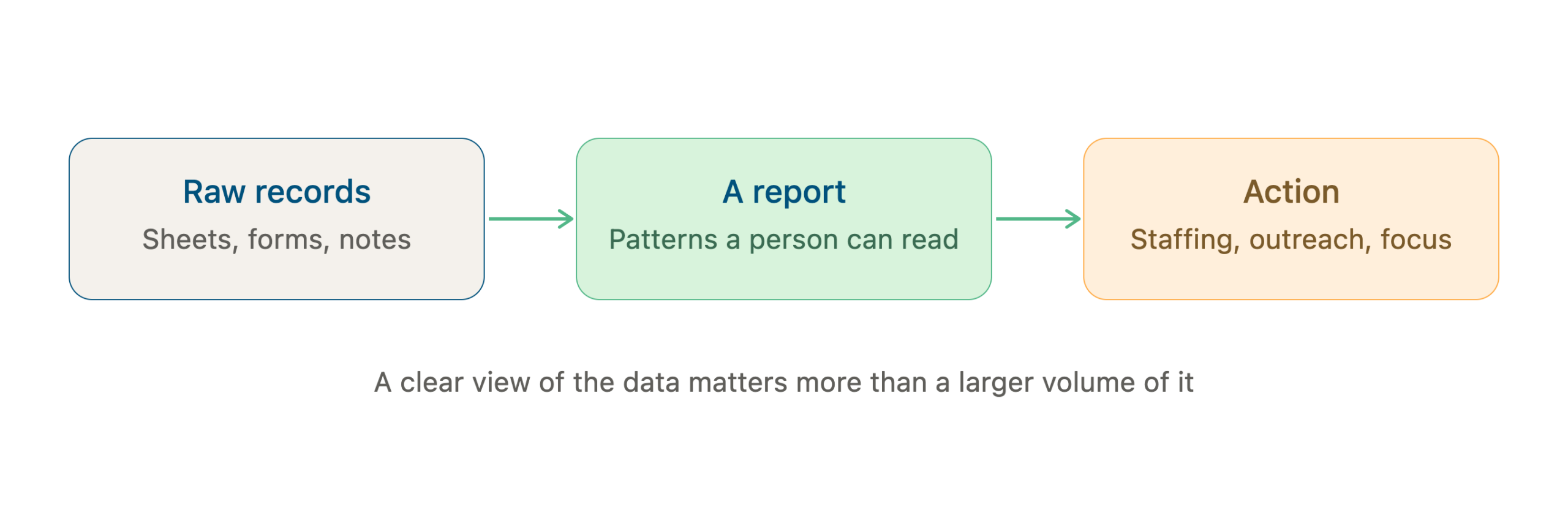
A report changes what programs can see by organizing tracked data into patterns a person can actually read. For example, a report might show attendance broken down by site, enrollment trends by month, or engagement patterns across activities. Raw records rarely show those patterns on their own.
The Forum for Youth Investment, in their study “Continuous Quality Improvement in Afterschool Settings: Impact Findings from the Youth Program Quality Intervention Study,” evaluated an approach in which site teams received standardized data on instructional practice and used it to plan specific improvements.
Teams with access to that structured data engaged in continuous improvement practices far more consistently, and instructional quality improved as a result. A clear view of the data mattered more than a larger volume of it. That clarity helped staff identify specific fixes.
Most OST programs get stuck in that same gap, between having data and being able to see it. A binder of attendance sheets and a clean report can both show identical numbers. However, only one tells a program director where to focus this week.
Putting reports to work
Programs get the most value from their reports by doing three things. They review reports on a regular schedule, tie findings to decisions, and cut the manual work between data and action.

Waiting for a funder’s deadline to force a review often misses the point. A pattern in enrollment or attendance can go unnoticed for months. Nobody looks again until renewal season forces the issue.
A report only earns its keep when a director acts on what it shows. This could mean adjusting staffing at a site with declining engagement, reaching out to families before a program loses enrollment, or figuring out which activities are actually driving the outcomes funders care about.
Staff capacity is already a real constraint for most programs, as indicated by the Wallace Foundation. Every hour spent compiling numbers by hand is an hour that could go toward acting on what those numbers show.
For California school districts, for example, this kind of school district compliance reporting isn’t optional. California law requires ASES and 21st CCLC school district programs to run a continuous, data-driven quality improvement process. This falls under California Education Code Section 8484(a)(2).
The kind of software school districts need to close this gap
Solving the visibility problem usually comes down to school district management software, the system behind the tracking. A program needs one that automatically pulls attendance, enrollment, and engagement data into one place. That same system should turn the data into a report, without someone having to rebuild it by hand every time a funder asks.
We built AfterSchool HQ to track attendance and headcounts, enrollment and demographic records, and engagement data in a single system rather than scattered across spreadsheets and paper forms. Reports then pull directly from that data, rather than requiring a manual rebuild.
A two-way nightly sync with district student information systems, including PowerSchool, Infinite Campus, and Aeries, keeps enrollment and demographic data up to date. Staff never have to re-enter it. Meanwhile, attendance and program data flow back out automatically.
For California programs specifically, that same data structure produces CALPADS-ready reports for ELO-P, ASES, and Attendance Recovery. As a result, the reporting required under Education Code Section 8484(a)(2) comes from information the program is already tracking, not a separate project.
The time savings show up in the gap between collecting data and acting on it. That’s exactly the gap the research above points to.
Frequently Asked Questions
1. What’s the difference between tracking data and reporting on it?
Tracking is collecting the raw information: attendance sheets, enrollment forms, engagement notes. Reporting is the process of organizing that information into something a person can actually read and act on. For example, that might mean attendance broken down by site over time. A program can track plenty of data and still have no usable reports if nobody turns it into that structure.
2. Why do after-school programs struggle to turn their data into useful reports?
The primary challenge is staff capacity. The Wallace Foundation found that turning raw data into usable information takes real time. Many OST programs simply don’t have enough of it. The problem gets worse when different funders require the same data in different formats.
3. Does reporting on data actually lead to real program improvements, or is it just paperwork?
Yes. When site teams have access to clear, standardized data, they engage in continuous improvement practices far more consistently. Instructional quality improves as a result.
4. What should after-school program management software actually do to solve this?
It should automatically pull attendance, enrollment, and engagement data into one place. That way, reports build themselves from information already being tracked, instead of requiring a manual rebuild. A two-way sync with the district’s student information system also removes one of the most common sources of duplicate entry.
5. How does attendance tracking fit into after-school data reporting?
Attendance tracking is one of the core inputs. Once attendance and headcounts are logged consistently, that data becomes the foundation for school district reporting, showing patterns like which sites or programs have declining participation before it becomes a bigger problem.
6. What is AfterSchool HQ?
AfterSchool HQ is a program management software designed for out-of-school-time providers. It covers attendance, enrollment, registration, and reporting in one system. It also includes a two-way nightly sync to district student information systems, such as PowerSchool, Infinite Campus, and Aeries.
7. Does AfterSchool HQ produce CALPADS-ready reports for California programs?
Yes. AfterSchool HQ generates CALPADS-ready reports for ELO-P, ASES, and Attendance Recovery. These come from the same attendance and enrollment data programs are already tracking.
8. Does AfterSchool HQ replace our student information system, or work alongside it?
It works alongside it. AfterSchool HQ syncs nightly with district SIS platforms. It pulls in enrollment and demographic data, and sends attendance and program data back out. That way, it never duplicates what the district system already manages.
9. Are after-school programs legally required to report this kind of data?
For California ASES and 21st CCLC programs, yes. California Education Code Section 8484(a)(2) requires a continuous, data-driven quality improvement process (California Department of Education, 2009). However, requirements vary for other program types and funding sources.
Sources
- Wallace Foundation. (2017). Measuring Youth Development: How Out-of-School Time Programs Collect and Use Data.
- Smith, C., Akiva, T., Sugar, S., Lo, Y. J., Frank, K. A., Peck, S. C., Cortina, K. S., & Devaney, T. (2012). Continuous Quality Improvement in Afterschool Settings: Impact Findings from the Youth Program Quality Intervention Study. Forum for Youth Investment.
- California Department of Education. (2009). Quality Improvement Process Guidance, referencing California Education Code Section 8484(a)(2).