

A pre/post survey asks youth participants or staff the same questions twice: once before a program starts and again after it ends. The gap between the two answers measures the outcome. It’s the standard method out-of-school time (OST) programs use to track growth in confidence, engagement, academic behavior, and social-emotional skills, and it’s the evidence funders expect in a grant report.
If your team is piecing that evidence together from paper forms or scattered spreadsheets, here’s what solid pre/post structure looks like in practice, where it tends to fall apart, and what a workaround looks like when the timeline gets tight.
What a Valid Pre/Post Survey Design Requires
Three conditions hold this design together:
- Identical wording at both points. A different question at pre and post measures two different things, not the same thing over time.
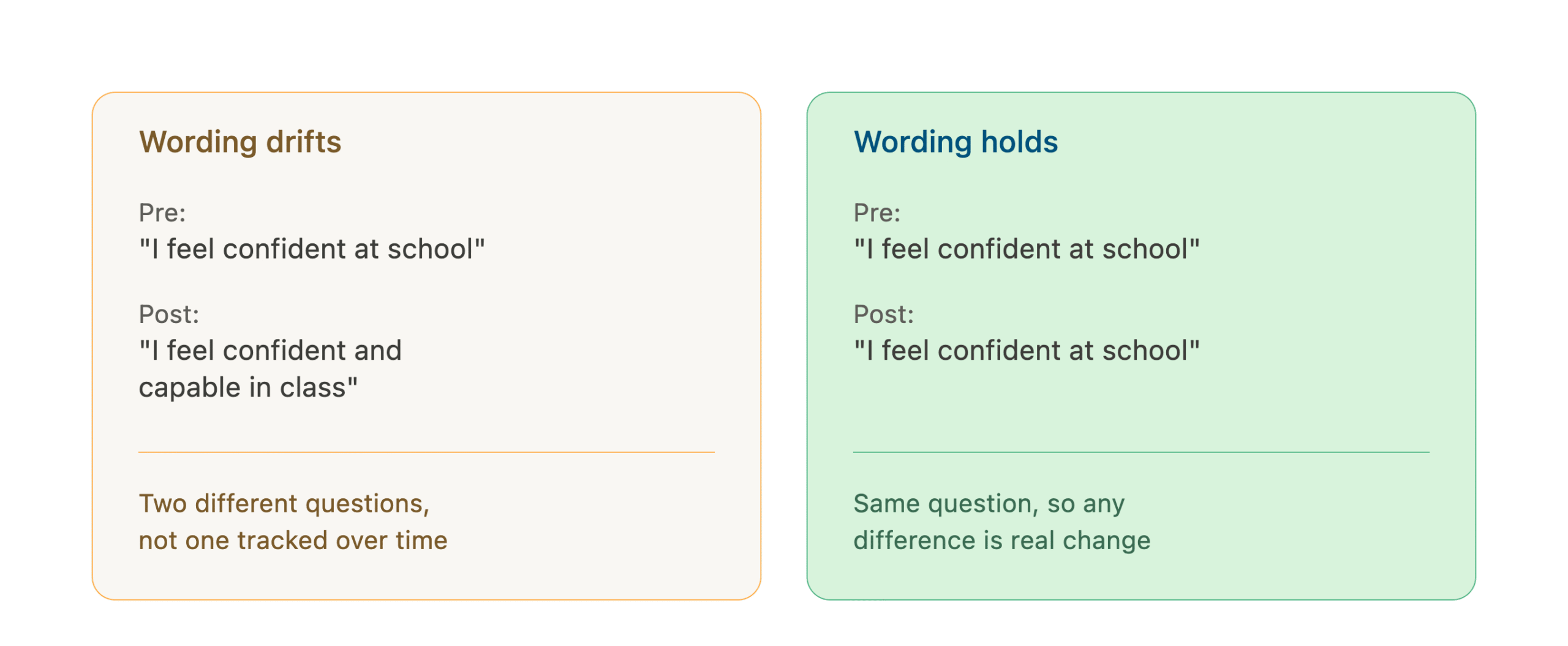
- The same student is completing both surveys. For staff-report tools, that means one staff member rating a given youth at both points rather than swapping mid-year. This aligns with the guidance for SAYO-S&T specifically, which calls for the same individual or team to complete both the pre- and post-surveys for a given youth.
- A real gap between the two measurements. For attitudes or knowledge, pre- and post- can sometimes happen close together. For behavior change specifically, the post-survey needs to wait long enough for the behavior to actually show up.
Youth Self-Report and Staff Ratings Measure Different Things
OST measurement tools typically use both approaches, since each captures something the other can’t. The Survey of Academic and Youth Outcomes (SAYO), developed by the National Institute on Out-of-School Time and now the reference tool for 21st CCLC evaluation, includes two distinct tracks:
- Staff and teacher surveys rate observable behavior: engagement in learning, problem-solving, peer relationships. Adults watching a child day to day tend to judge this more consistently than the child rating themselves.
- Youth surveys stay narrower, covering program experience, sense of competence, and future expectations, typically with simple scales rather than full agreement ranges.
SAYO was field-tested with more than 5,000 students and found to be reliable across age groups and genders, which is part of why it’s become the standard reference point for 21st CCLC evaluation.
How to Word Survey Questions for Younger Respondents
A handful of wording habits show up consistently in youth-facing surveys:
- Short sentences and age-appropriate vocabulary. If a question needs explaining before a child can answer it, the answer usually reflects a guess rather than a real response.
- One idea per question. “I feel confident, and I make friends easily” bundles two separate claims into a single answer, so a low score doesn’t tell you which one it’s actually about.
- A consistent response scale throughout the survey. Switching from a Yes/No format to a five-point agreement scale partway through adds noise to the data unrelated to the program.
- A stated timeframe. Adding “in the last few weeks” anchors the answer to the program itself. Without it, a child may be describing how they generally feel rather than what changed during the program.
When There’s No Time for a True Baseline Survey
Enrollment moves fast, and staff is stretched thin, so the “pre” survey window sometimes closes before the paperwork catches up. A documented alternative for this is the retrospective pre-post survey, where both “where were you before” and “where are you now” are asked in the same sitting, usually near the program’s end.
Research on this design, going back to Howard’s original work on response-shift bias in 1980, has repeatedly found that retrospective surveys often reveal more reported change than traditional before/after methods. The explanation is response-shift bias: a participant’s internal sense of their starting point can shift as they grow, making their remembered “before” appear lower than what they actually reported at the time. More recent research is careful to note this effect doesn’t show up in every study, so a retrospective survey isn’t automatically more accurate, just a documented and reasonable option.
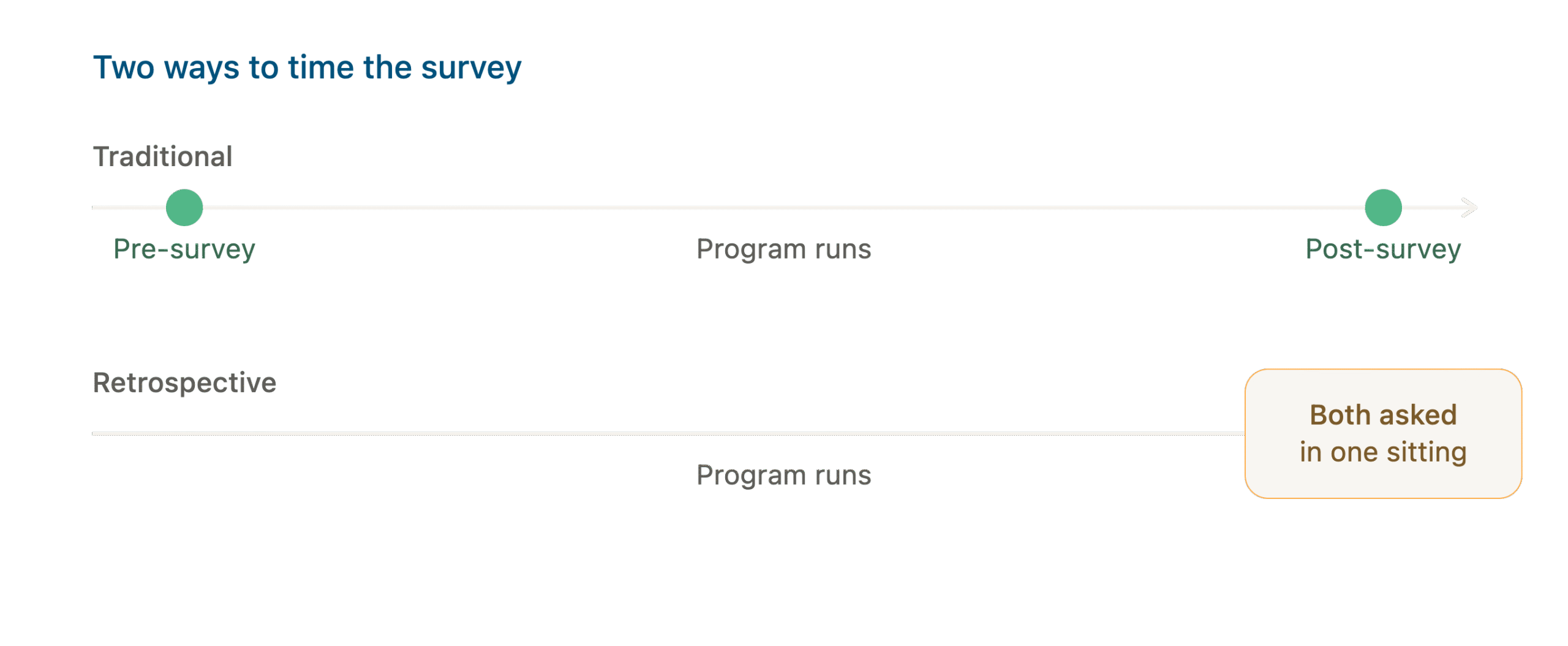
It isn’t a substitute for a true baseline when time allows for one, but when it doesn’t, it’s a reasonable way to still capture usable evidence.
Why Question Structure Affects Funding Outcomes
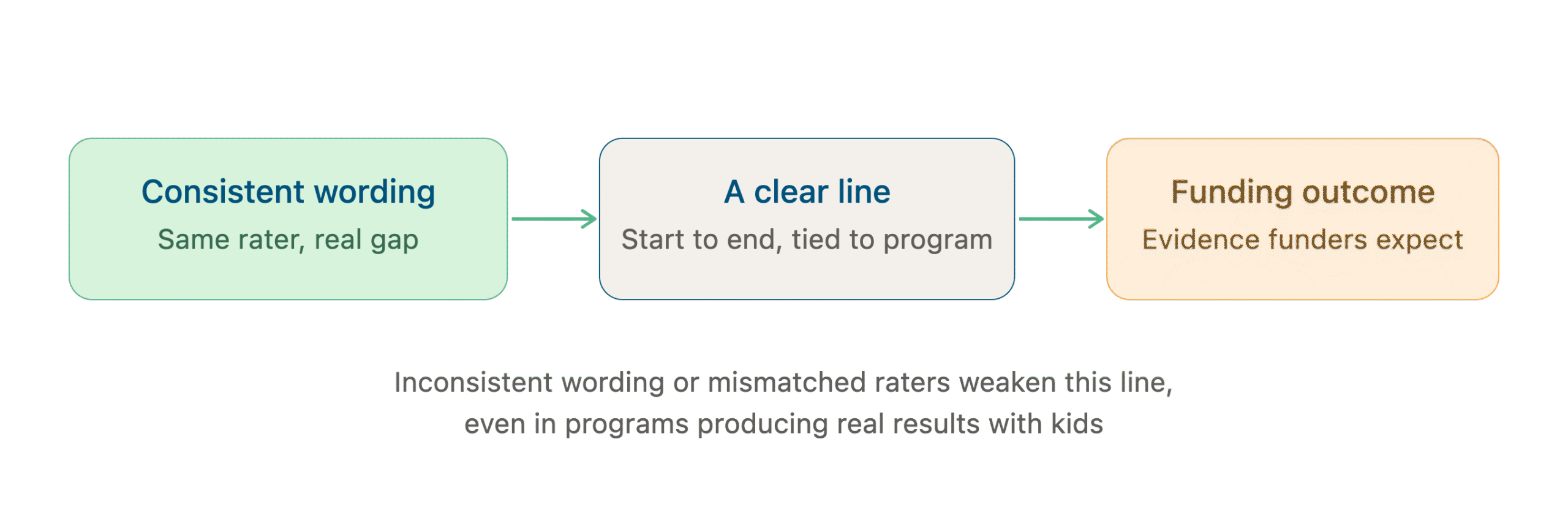
Funders look for a clear line from where participants started to where they ended up, with the program as the reason for the change. Inconsistent wording or mismatched raters weakens that line, even in programs producing real results with kids.
Managing this by hand gets harder with every additional site and every round of staff turnover. Centralizing question design and data collection in a single system makes it easier to maintain consistent evidence without adding extra weekly work for staff.
AfterSchool HQ’s survey tool lets programs build and send pre- and post-surveys from one place, so the same wording and format go out at every site, every time. Book a quick demo to see how it fits into your program’s evaluation cycle.
Frequently Asked Questions
What is a pre/post survey in an after-school program? A pre/post survey asks the same questions to the same person before a program starts and again after it ends, so the difference between the two answers can be used as a measure of change.
How long should the gap be between the pre- and post-survey? It depends on what’s being measured. Attitudes or knowledge can shift quickly, so a shorter gap can work. Behavior change takes longer to show up, so the post-survey needs enough time to pass for that change to actually be visible.
Does the same staff member need to complete both surveys for a given youth? Yes, for staff-report tools. SAYO-S&T guidance specifically calls for the same individual or team to rate a given youth at both points, since switching raters mid-year introduces inconsistency unrelated to the youth’s actual progress.1
Is SAYO required, or can programs design their own survey? SAYO is a widely used, field-tested option, not a requirement. Programs can design their own pre/post surveys as long as they follow the same core principles: identical wording, the same rater or respondent, and a real gap between measurements.
What is a retrospective pre-post survey, and when should a program use one? It’s a survey in which both the “before” and “after” questions are asked simultaneously, usually near the end of a program. It’s a documented workaround for programs that miss the window for a true baseline survey, not a replacement for one when there’s still time to collect it properly.